Showing posts with label digital tools. Show all posts

Saturday, November 5, 2011

Jobs on computers in schools

From the New York Times, 5 November 2011. I guess it does take more than a computer for learning to take place.

Even Mr. Jobs, Apple’s co-founder, turned skeptical about technology’s ability to improve education. In a new biography of Mr. Jobs, the book’s author, Walter Isaacson, describes a conversation earlier this year between the ailing Mr. Jobs and Bill Gates, the Microsoft co-founder, in which the two men “agreed that computers had, so far, made surprisingly little impact on schools — far less than on other realms of society such as media and medicine and law.”

The comments echo similar ones Mr. Jobs made in 1996, between his two stints at Apple. In an interview with Wired magazine, Mr. Jobs said that “what’s wrong with education cannot be fixed with technology,” even though he had himself “spearheaded giving away more computer equipment to schools than anybody else on the planet.”

Monday, January 17, 2011

What if Reading On the Computer Means We Don't Get It?


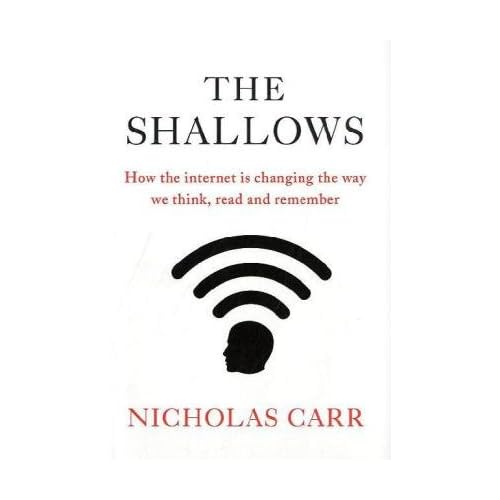
After having recently read The Shallows by Nicholas Carr, I decided to do an experiment with my students. According to the research described in the book, reading comprehension is highest with traditional paper (book, article etc.).

I have been trying to minimize my environmental impact both in my personal and professional life for many years. Since joining ISB, I have been able to make great strides towards reducing my/my students’ paper consumption because of the availability of electronic texts. I post articles on my class blog for students to download or read online.

Knowing that reading is often not enough to come to a deep understanding, I teach my students to use tools like the highlighting and note-taking functions of Preview (on a Mac), diigo.com and coda notes (to name just a few). These allow users to make notes, highlight and mark up webpages/texts just as they would with paper and pen.

Like most people, and like most of my students, most of my reading for information happens on a computer these days. I read the news, read scholarly articles for my Master’s research project and find class texts online. I feel like my comprehension is excellent. So, when I read The Shallows and the research it references about the difference in comprehension with paper reading, I was truly skeptical. I believed, if anything, that the difference came down to individual reading/learning styles and decided to test it myself.

I chose three different articles that are about the level that I would normally assign for current events, two of them from the New York Times. For Grade 6, this can be a fairly challenging reading level. Each article was followed by five questions related to comprehension of the key information from the article. The subject of each article was familiar but the information was ‘new’ to the students. I did the experiment with both of my Humanities classes – about 40 students.

For article one, students read entirely online. They could take notes on paper or using an online tool.

For article two, students read a pdf version stripped of all ads (using the ‘READER’ function of Safari). They could then take notes on paper or using Preview (which allows them to take notes and highlight the text easily).

For article three, students received a paper copy of the article and could write on it if they needed to. If I am being honest, this article was in fact the longest and most complex.

The results?

For the first article (reading online), the class average was 68%, a D+.

For the second article (a pdf version that allowed note-taking), the class average was 72%, a C-.

For the final article (a paper copy), the class average was 89, a B+.

I shared this information with my students and I am sharing it now because we all need to know how we are most successful. So far, I am not printing all new readings for my students, but I am encouraging them to print them if they need to. I make pdfs available for all readings and encourage students to print them if they find them difficult.

I was skeptical and am still not entirely convinced, but these results are pretty compelling. If it were just my little experiment giving these results, I would not take it as seriously, but my results reflect the result of large academic studies. The results are too important to ignore them. I still want to go paperless, but I believe that we should all know that how we do things has an impact on how successful we are. I want my students to think of that as well.

Friday, March 26, 2010

Coetail Final Project: 27 March 2010

Thanks to one of my teammates I implemented a new dimension to our book clubs last week. As I have mentioned before, students book club participation was quite good. I was impressed by their preparation and by their level of examination and analysis of their shared texts. However, they are limited by their age/experience and can't always get to some of the key issues in a novel the way they could with some teacher guidance.

During book club meetings, I have always floated and, though mostly listening, offered suggestions to deepen the conversations. This is interesting but limited in that I want to hear more and, in some cases, draw students' ideas out more. As a student I have never liked someone dropping in and adding their two cents to a conversation that has been moving along just fine without them, so I have tried to avoid doing it too much as a teacher. Nevertheless, a teacher can guide a discussion in a way that a group of 12 year olds cannot.

So back to the "new dimension". Following my colleague's example, I set up a chat on todaysmeet for each book club (after previously giving them play tim on the chat site the day before). I had explained the guidelines and why I was using chat with them instead of the usual format, so the day of the discussions we just got started. I was pretty happy with the result.
I was able to:

  • meet with individual groups for extended amounts of time;
  • participate when I thought it was advantageous;
  • participate with them without being a drop-in;
  • draw out bigger ideas from students who had the germ of an interesting topic;
  • just simply listen for a while without any interruption;
  • get a transcript of all the virtual discussions;
  • review those for topics for whole class discussion at a later time;
  • and get a better sense of the body of group's discussion.
It was a positive experience in many ways, but possibly the most interesting was the follow-up whole class discussion. I was curious about students' reactions to the format. In both classes, about 41 out of 45 students liked using chat. About 36 of 45 said we should use it occasionally (that was my suggestion because I would not use it exclusively in place of face-to-face). [This next one is most interesting to me because to me it shows they understand the different levels of communication offered by face-to-face interactions.] All of them agreed that they had better discussions about the important aspects of the novel face to face.

They cited the things you would expect...spontaneity, flow, limits of typing speed etc. All in all, though, I was pretty happy to have a new tool to use.

Saturday, March 13, 2010

Coetail Final Project: 12 March 2010

We just finished up conferences and I found a new way for technology to play a part. I have used digital tools in conferences for several years, mostly in the form of students electronic portfolios. Blogs, videos, audio recordings and wikis have provided a great reference point for students' discussion of their work and progress.

During today's conference, however, I hit upon a new use. I have a particularly outstanding student from Korea whose mother doesn't not speak English fluently. She relies on her daughter to translate much of what I say. From past experience, I know that this exemplary student is also exceedingly modest. In the first semester conferences, it was obvious that she did not fully translate the praise I heaped upon her. She blushed and giggled but her mother did not react in the way I would have expected given how highly I regarded her daughter's academic prowess. Clearly, something was being (deliberately) lost in translation.

This time, I decided, I would not be similarly foiled. I typed several select phrases in google translator and watched as her mother grinned in delight. The student, not surprisingly, blushed and laughed but looked thrilled to have her mother 'hear' what I really had to say. In the end we finished the conference in a very good mood.

그녀는 놀라운 학생이다.

난 다행 회의 완료됩니다.

I hope that's right. In the conference, several things did not make sense but the gist got through. When my Spanish students use it, it is OBVIOUS.